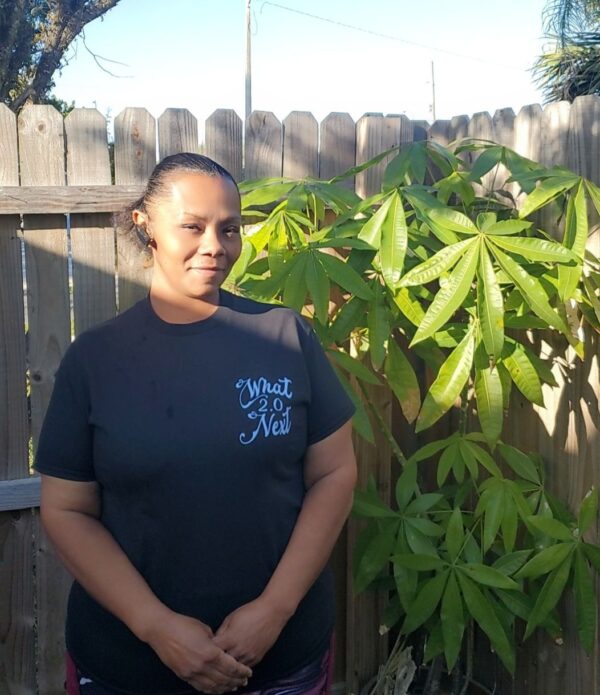
My name is Venessa 
I’m one of the Ambassadors who takes calls for Brain Injury Florida on the Information & Referral Line (BIL), supporting brain injury survivors like myself. I’m also active in the social media community as an advocate—not just for me, but for others walking this same journey, making sure they know they’re not Alone.
Our personal battles can become someone else’s inspiration. Everyone has a story too powerful to keep hidden.
Advocacy has become more than just answering calls and helping people find resources. I also volunteer at a food pantry, where we serve about 65–80 families a day, five days a week. The numbers used to be higher, but due to budget cuts, we’ve had to reduce how many families we can help—just to make sure we can continue serving those in need.
When I was released from the hospital, I was told I could go back to doing whatever I wanted. I could walk, I could talk, and to everyone else, I looked “FINE” But short-term memory, cognitive function, Brain fog, mental clarity, fatigue, Balance issuses and burnout—these challenges are real, and they look different for many of us.
What I didn’t realize at the time was how much I would go through after surviving an aneurysm rupture. Because I looked the same, my family believed everything would go back to normal—and so did I.
I’m incredibly grateful for the support group I found early on in my recovery back in 2019. That was a very difficult time, and joining that group opened so many doors for me. It connected me to resources and people who truly understood.
That experience is what drives me today—to help others find what’s available and to understand that life will be different… and that’s okay.
Acceptance is part of the journey.
On August 9, 2022, I received an email from my recreational nurse from my group asking if I wanted to be part of a new brain injury advocacy program here in Florida. They had received a grant and were looking for board members—and she thought of me.
She believed I could be a voice for brain injury survivors in Florida, especially since there aren’t many resources available once someone leaves the hospital.
Of course, I said yes 
Now, four years later, I’m honored to still be part of it and to watch it grow into something meaningful. From that very first meeting, I knew we were building something important.
One thing I’ve learned along the way is that access to information is everything—but finding people willing to share it isn’t always easy. Even now, I still encounter challenges. That’s why I do what I do—because everyone deserves access, support, and understanding. What I do every day comes from the heart. This is for me, and for everyone on their own unique journey.
I’m a daughter.
I’m a sister.
I’m a wife.
I’m a mother.
Before my injury and after my injury, I have always worked hard at whatever I do. As a brain injury survivor, I give myself Credit. You would never know what I’ve been through just by looking at me.
You would only know if you truly LISTENED
Yes, it’s real.
No, I’m not pretending.
And yes, I have the medical documentation to prove it.
Trust me… I didn’t ask for this. But here’s why I’m sharing today.
Recently, I attended an event surrounded by people living with invisible disabilities. Looking around the room, I realized something very important: You couldn’t tell who was struggling and who wasn’t. That event reminded me of something that we all need to practice more —slow down and pay attention to the people around you. Not everything in life is a rush. Because the truth is, you never know what someone is carrying. Just like you wouldn’t know what I’m carrying if I didn’t tell you.
You wouldn’t know I live with a brain injury.
Seven years ago, on February 5, 2019, my life changed unexpectedly. I suffered a ruptured cerebral aneurysm and a hemorrhagic stroke—A type of Acquired Brain Injury (ABI). The kind you rarely HEAR about. What I didn’t know was that it was genetic, and that i had two aneurysms one on the left an one on the right. The one on the right has been repaired with a stent and coils. The other is still being monitored yearly with MRA
I was in a coma for 8 days and hospitalized for 21 days. When I woke up, I was confused. I didn’t know what had happened or where I was. I had lost days of my life that I will never get back I didn’t get it…
And yet today—I walk, I smile, and I SHOW UP.
For the first three years, I lived in fear every day. Pero I didn’t show it. Most people couldn’t tell what I was going through because brain injury is INVISIBLE.
The lights were too bright.
The color red hurt my head.
Noise was overwhelming.
Being around people was exhausting.
My memory changed.
Overstimulation was real.
I had to find a new normal. A new version of me. Chach and the hardest part was accepting that the old version of me wasn’t coming back. Along this journey, I lost people I thought would always be there. But I’ve made peace with that. Not everyone is meant to stay. What I won’t accept is anyone telling me how to heal or how long healing should take.
Brain injury is a life Sentence. Chacho living this life requires a different kind of strength.
That’s why I’m very selective about who I allow in my space. My peace is worth every minute. I celebrated my Survivors Anniversary last month not as a reminder of trauma, but as a celebration of my life an how far I’ve come. I celebrate the small wins. I celebrate progress—no matter how slow. Because progress is still progress. Seven years later, I’ve learned something important:
Healing isn’t about rushing back to who you were.
It’s about learning to live fully with who you are now. And even though life is different, it can still be meaningful, purposeful, and beautiful an full of some amazing moments.
Today, I give back by volunteering with Brain Injury Florida, helping answer calls so survivors know they are not alone. I also volunteer at MSS Food Pantry, helping feed families in need. We serve about 65–80 people a day—nearly 1,400 a month. Helping others helps me heal. Advocating for myself—and others—is everything. Because if you don’t advocate for yourself, many times NO ONE else will.
ESPECIALLY when you DON’T ’t look like what people expect a survivor to look like. So the next time you see someone, don’t rush to judge them. Have compassion.
If you don’t understand invisible disabilities, take the time to educate yourself.
Still healing.
Still learning.
Still advocating.
Still grateful.
Mommy, I hope I’m making you proud.

 I’m incredibly grateful for the support group I found early while I was in my recovery back in 2019. That was a very difficult time for me, and joining that group opened so many doors for me. It connected me to resources and people who really understood this world. Invisible injury That experience is what drives me today—to help others find what’s available and to understand that life will be different… and that’s okay. Acceptance is part of the journey. “It took a lot to get here”
My journey started long before my injury an I didn’t even know it. I lost my mom to a hemorrhagic stroke in 1989 in Brooklyn, New York—the same type of injury that I experienced on February 5, 2019. So this fight is harder then i expected. In honor of those we’ve lost—especially my mom  This journey hasn’t been easy. It has been challenging. But I’ve learned that acceptance and balance is key. Having a voice matters—especially when it represents those who can’t speak for themselves and those we’ve lost along the way.
Each one, teach one.
No one should feel alone.
What I hope to see in the future is more support—more counselors to help us understand before we are discharged, more social workers to assist with paperwork while we are in the hospital, more neuropsychologists to conduct thorough testing before release, and even more legal resources to help survivors and families navigate everything, because not every case is only medical.
Thank you for reading.

Leave A Comment
You must be logged in to post a comment.